Page Content
PHOTOGRAPHER: ZAK (((again)), FLICKR
Tens of thousands of protestors gathered at Wisconsin’s state legislature on
February 19, 2011, to show their opposition to Governor Scott Walker’s Wisconsin Budget Repair Bill.
“There’s power in numbers and solidarity.”
 That’s what Liz Wingert, a Grade 1 teacher in Madison, Wisconsin, identifies as one of the lessons of the Wisconsin protests of 2011. Wingert, who played a key role in the protests, sat down with the ATA News following her April 21 presentation to Public Interest Alberta’s annual advocacy conference in Edmonton.
In 2010, Wisconsin Republican gubernatorial nominee Scott Walker ran on a fiscal platform that did not include collective bargaining. Elected governor in November with 52 per cent of the popular vote, Walker introduced the Wisconsin Budget Repair Bill in February 2011 to address a projected $3.6 billion deficit. Among other things, the bill sought to eliminate collective bargaining rights for public-sector employees, excluding police and firefighters; base their wage increases on the consumer price index; and increase employees’ contributions to their health insurance and pension plans.
“What really happened was [Walker] created a fake financial crisis,” Wingert recalls. “He gave tax loopholes to businesses and corporations, trying to encourage them to locate in Wisconsin, and what that created was a budget deficit which he tried to balance on the backs of union members.”
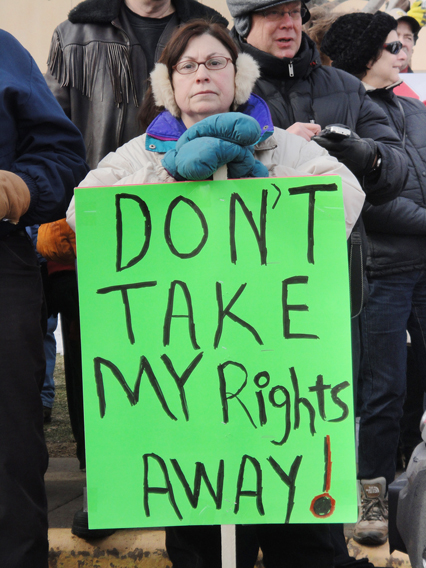
One of the many demonstrators who gathered in Hudson, Wisconsin, on February 19, 2011.
A group of Madison high school students led the opposition to the budget repair bill, staging a mass walkout, and public-sector unions, including Madison Teachers Inc. (MTI), followed suit. The evening of the student walkout, Wingert, an MTI faculty representative, attended a meeting of union members at her school, and MTI used its phone tree to determine whether union members wanted to show up for work the next day or walk out in support of students’ futures. While some beginning teachers expressed concern about their untenured status and potential retribution, they were ultimately convinced that, the greater the number of teachers who walked out, the harder it would be for their school district to take action against them. In fact, so many members decided to walk out that the schools had to be shut down.
The teacher protestors were joined at the state capitol by other public-sector employees, including police officers and firefighters who had been exempted from the budget repair bill. The police officers “were smart enough to realize that eventually Walker would come after their collective bargaining rights, and so even though they were exempt from this rule, they . . . stood at the capitol in their official roles as police officers during the day, and at night they’d go home and change their clothes and come back and protest with ‘Cops for Labor’ signs,” Wingert says. The firefighters also held “processions through the streets with their full regalia and bagpipes—very emotional processions because people understood they were still fighting for us even though their collective bargaining rights were not being infringed at that point.”
Following four days of political action, MTI members voted narrowly in favour of returning to work in order to retain the public support they had garnered. Other protestors, including parents, replaced them at the capitol.
The protestors occupied the state capitol for almost a month, and financial support streamed in as the protests continued. A nearby business, Ian’s Pizza, started delivering free pizza to the protestors and ultimately received donations from all 50 states and from 60 countries, including a donation from an Egyptian protestor in Tahir Square, to continue feeding the protestors.
By this time, protestors were sleeping in the capitol building, and the government tried to end the protests by locking the doors to prevent the delivery of food, bolting the bathroom windows shut and blaring news reports through the speaker systems in the wee hours of the morning. When those tactics failed, the government successfully evicted the protestors by making it illegal for them to sleep in the capitol building.
In order to prevent a vote on the budget repair bill, 14 Democratic senators, including one who was in the late stages of pregnancy, left Wisconsin for 40 days for an undisclosed location. However, when Walker attached the bill to the budget to make quorum unnecessary, the legislation was passed.
It was immediately challenged by union lawyers, in some cases successfully. The courts ruled that, while the unions could bargain, they could bargain only on the base wage and, even then, only on the basis of the consumer price index. Public-sector employees were also asked to pay more for their health insurance and pension plans.
“The biggest problem was people were being asked to pay more into their health insurance and pension, which sounds really good to private-sector employees,” Wingert recalls. “[Walker] was very successful in . . . pitting private-sector employees against public-sector employees, painting the public-sector employees as the haves and the privates as the have-nots. . . . So instead of saying, ‘Hey, we should have what they have,’ they thought, ‘They shouldn’t have that because I don’t have it.’”
The fallout continues. Wingert was among the union members who organized a petition to recall Walker. The organizers collected one million signatures on the petition (only 750,000 signatures were required), and on June 5, Wisconsin voters will vote on whether to recall their governor.
Wingert advises Alberta teachers to take action to prevent a similar situation from happening in the province. They should seek to expose political party donors, determine who each policy benefits and who it disenfranchises, and convey those messages to the public, she says.
“One mistake that our governor made was to take so many drastic measures at the same time that the public couldn’t ignore it.” What I have seen since then is Republican governors being a little more stealth in how they do things so that it doesn’t cause a political uproar. . . .
“We [also] learned . . . that we needed to be in solidarity with other unions . . . that there’s power in numbers and solidarity, that they may have the money flowing in but we outnumber them and that our vote is our voice and we need to protect it and encourage others to use it.”